
VEDORA · BOARD EXAM PREPARATION

Let's prepare for your
CBSE Class 10 & 12 boards2026–27 Academic Session

Try real CBSE board questions, understand your mistakes, and discover what to work on next.

Our focus right now: CBSE Class 10 & 12 Maths

v. A LITTLE PRACTICE. A NEW UNDERSTANDING.
THE LEARNING LOOP
Class 12 · Student attemptQ1 · Differentiation

A good method.
One sign to fix.

VEDORA GRADING1/5
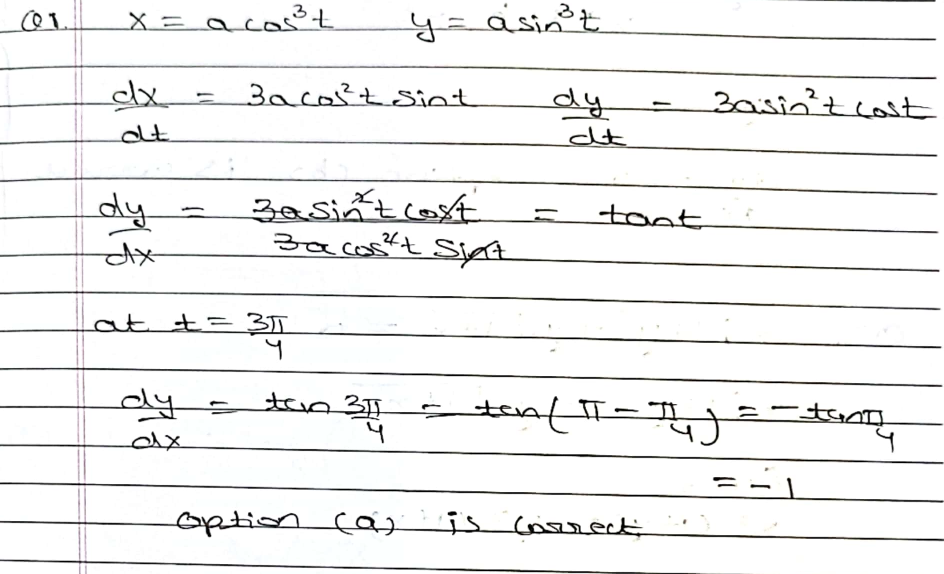
The student writes dx over dt as positive 3a cos squared t sin t, then obtains dy over dx equals tan t and chooses negative 1. The missing minus sign begins in dx over dt.
The student’s original workingEnlarge
FROM VEDORA’S GRADING REPORTOpen report

Question 1

1/5 marks
THE CORRECTED FIRST STEP
dx/dt = −3a cos²t sin t
Read Vedora’s full grading

You used parametric differentiation which is the right idea. You made a sign error when differentiating x = a cos³t and that led to a wrong final choice. Fix the sign and the answer becomes D (1).

The question

For x = a cos³t and y = a sin³t, find dy/dx at t = 3π/4.

(A) −1 · (B) −1/√3 · (C) −√3 · (D) 1

What went well

  • Used dy/dx = (dy/dt)/(dx/dt).
  • Found dy/dt = 3a sin²t cos t correctly.
  • Evaluated tan(3π/4) correctly, although it followed an incorrect derivative.

Why Vedora awarded 1/5

Partial credit was given for the correct dy/dt. The missing negative sign in dx/dt affected the ratio and the final answer.

What to improve · Moderate

When differentiating cos³t, include the inner derivative: d(cos t)/dt = −sin t. Practise powers of sine and cosine and check the sign at each step.

The complete result

dx/dt = −3a cos²t sin t
dy/dt = 3a sin²t cos t
dy/dx = −tan t
At t = 3π/4: −tan(3π/4) = +1

The correct choice is D (1).

Open the full product report and solution
Student attempt · Feedback and marks by Vedora
Your working is a clue to what could help next.
FOR SCHOOL LEARNERS.
Starting with a focused purpose.
6–12

Classes we welcome

About our focus

YOUR WORK. YOUR NEXT STEP.

Every attempt should
teach you something.

Vedora looks beyond right or wrong. Understand your mistakes, discover which concepts need work, and turn every attempt into a clearer path for what to practise next.

  1. A mathematics question paper: solve x squared minus 5x plus 6 equals zero. CBSE MATHS · CLASS 10Solve the equation.x² − 5x + 6 = 0Quadratic equations

    Solve questions. Upload your work.

    Find CBSE PYQs and practice questions on Vedora. Solve on paper, then upload a photo of your working.

  2. Vedora highlights the omitted second root, x equals 3, and explains that both factors must be checked. vedora.FEEDBACK(x − 2)(x − 3) = 0x = 2x = 3One more root.Check both factors.

    See your mistakes. Understand why.

    Get feedback on your steps and simple explanations of the concepts behind your mistakes.

  3. A follow-up practice question on the zero-product property: x minus 4 times x plus 1 equals zero, with space for both roots. NEXT FOR YOUZero-product property(x − 4)(x + 1) = 0x = ?x = ?

    Get practice that helps you improve.

    Try follow-up questions based on your mistakes and check what you’ve learned.

One illustrated Maths example. A useful next step for every attempt.

SOMETHING TO TAKE WITH YOU

Now try it
on paper.

Your practice sheet

vedora.Class 10 Maths · 3 questions
  1. Quadratic equations

    Solve x² − 7x + 12 = 0 by factorisation. Show each step.

    Need a hint?

    Find two numbers whose product is 12 and sum is −7.

    View worked solution
    1. The numbers −3 and −4 have product 12 and sum −7. Split −7x into −3x − 4x.
    2. x² − 3x − 4x + 12 = 0. Group the terms: x(x − 3) − 4(x − 3) = 0.
    3. Take out the common bracket: (x − 3)(x − 4) = 0.
    4. A product is zero when at least one factor is zero. So x − 3 = 0 or x − 4 = 0.
    5. The roots are 3 and 4. Check: 9 − 21 + 12 = 0 and 16 − 28 + 12 = 0.

    Answer: x = 3 or x = 4.

  2. Coordinate geometry

    Find the distance between A(−2, 1) and B(2, 4). Show your substitution in the distance formula.

    Need a hint?

    The first difference is 2 − (−2), not 2 − 2.

    View worked solution
    1. Use AB = √((x₂ − x₁)² + (y₂ − y₁)²). Here A is (−2, 1) and B is (2, 4).
    2. Substitute carefully: AB = √((2 − (−2))² + (4 − 1)²).
    3. Subtracting a negative adds it: 2 − (−2) = 4. The other difference is 3.
    4. Square both differences: AB = √(4² + 3²) = √(16 + 9) = √25.
    5. Take the square root: AB = 5 units. The distance is positive.

    Answer: AB = 5 units.

  3. Trigonometry

    If sin θ = 5/13 and θ is acute, find cos θ and tan θ. Explain why you take the positive root.

    Need a hint?

    Use sin² θ + cos² θ = 1, then tan θ = sin θ / cos θ.

    View worked solution
    1. Use sin² θ + cos² θ = 1. Substitute sin θ = 5/13.
    2. cos² θ = 1 − (5/13)² = 1 − 25/169 = 144/169.
    3. Take the square root. Since θ is acute, cos θ is positive, so cos θ = 12/13.
    4. Use tan θ = sin θ / cos θ = (5/13) / (12/13).
    5. Cancel the common denominator: tan θ = 5/12.

    Answer: cos θ = 12/13 and tan θ = 5/12.

  1. 01Attempt it. Show your working.
  2. 02Stuck? Open a hint.
  3. 03Upload your answer to Vedora. Get feedback on every step.
Solved it? Get feedback.See the steps you got right and what to improve.Start practising
OUR FOCUS RIGHT NOW

CBSE Class 10 & 12 boards.
Starting with Maths.

Vedora welcomes school learners from Classes 6–12. We’re concentrating our current work on board preparation, while building towards support across subjects and stages of school.

Start practising

QUICK ANSWERS

A few things
you might ask.

Do I have to type my answers?

No. Work through the questions on paper and submit your handwritten solutions through the platform.

Where do I find questions to practise?

Find previous-year questions and practice questions on Vedora, then solve them on paper.

What if I don’t understand my mistake?

Vedora gives feedback on your steps and a simple explanation of the idea behind the slip, so you can try the next question with more clarity.

Join community